Showing posts with label Prayer. Show all posts

Friday, March 11, 2016

13th CENTURY DOMINICAN BLESSING

May God the Father bless us.
May God the Son heal us.
May God the Holy Spirit enlighten us,
and give us
eyes to see with,
ears to hear with,
hands to do the work of God with,
feet to walk with,
a mouth to preach the word of salvation with,
and the angel of peace to watch over us and lead us at last,
by our Lord's gift, to the Kingdom.


Amen.


Tuesday, March 08, 2016

PRAYER TO ST. JOSEMARIA ESCRIVA


O God,
through the mediation of Mary our Mother,
you granted your priest St. Josemaria countless graces,
choosing him as a most faithful instrument to found Opus Dei,
a way of sanctification in daily work
and in the fulfillment of the Christian’s ordinary duties.
Grant that I too may learn to turn all the circumstances
and events of my life into occasions of loving you
and serving the Church, the Pope and all souls with joy and simplicity,
lighting up the pathways of this earth with faith and love.
Deign to grant me through the intercession of Saint Josemaria,
the favor of… (make your request). Amen.
Our Father…
Hail Mary…

Glory be…


Monday, March 07, 2016

PRAYER OF ST. AUGUSTINE


Lord Jesus, let me know myself and know you,
And desire nothing, save only you.
Let me hate myself and love you.
Let me do everything for the sake of you.
Let me humble myself and exalt you.
Let me think of nothing except you.
Let me die to myself and live in you.
Let me accept whatever happens as from you.
Let me banish self and follow you,
And ever desire to follow you.
Let me fly from myself and take refuge in you,
That I may deserve to be defended by you.
Let me fear for myself, let me fear you,
And let me be among those who are chosen by you.
Let me distrust myself and put my trust in you.
Let me be willing to obey for the sake of you.
Let me cling to nothing, save only to you,
And let me be poor because of you.
Look upon me, that I may love you.
Call me, that I may see you,
And for ever enjoy you.
Amen.

ORATIO S. AUGUSTINI

Dómine Iesu, nóverim me, nóverim te,
Nec áliquid cúpiam nisi te.
Oderim me et amem te.
Omnia agam propter te.
Humíliem me, exáltem te.
Nihil cógitem nisi te.
Mortíficem me et vivam in te.
Quæcúmque evéniant accípiam a te.
Persequar me, sequar te,
Sempérque optem sequi te.
Fúgiam me, confúgiam ad te,
Ut mérear deféndi a te.
Tímeam mihi, tímean te,
Et sim inter eléctos a te.
Diffidam mihi, fidam in te.
Obœdíre velim propter te.
Ad nihil affíciar nisi ad te,
Et pauper sim propter te.
Aspice me, ut dilígam te.
Voca me, ut vídeam te,
Et in ætérnum fruar te.

Amen


Monday, September 22, 2014

PRAYER TO ST. JOHN XXIII

Oh, St. John, your simplicity and meekness carried the scent of God and sparked in people’s hearts the desire for goodness. You spoke often of the beauty of the family gathered around the table to share bread and faith: pray for us that once again true families would live in our homes.

With outstretched hands you sowed hope, and you taught us to listen for God’s footsteps as he prepares a new humanity: help us have a healthy optimism of defeating evil with good.

You loved the world with its light and darkness, and you believed that peace is possible: help us be instruments of peace at home and in our communities.

With paternal gentleness you gave all children a caress: you moved the world and reminded us that hands have been given to us not for striking, but for embracing and drying tears.

Pray for us so that we do not limit ourselves to cursing the darkness but that we bring the light, bringing Jesus everywhere and always praying to Mary. Amen.


St. Jon XXIII, pray for us.


Sunday, September 21, 2014

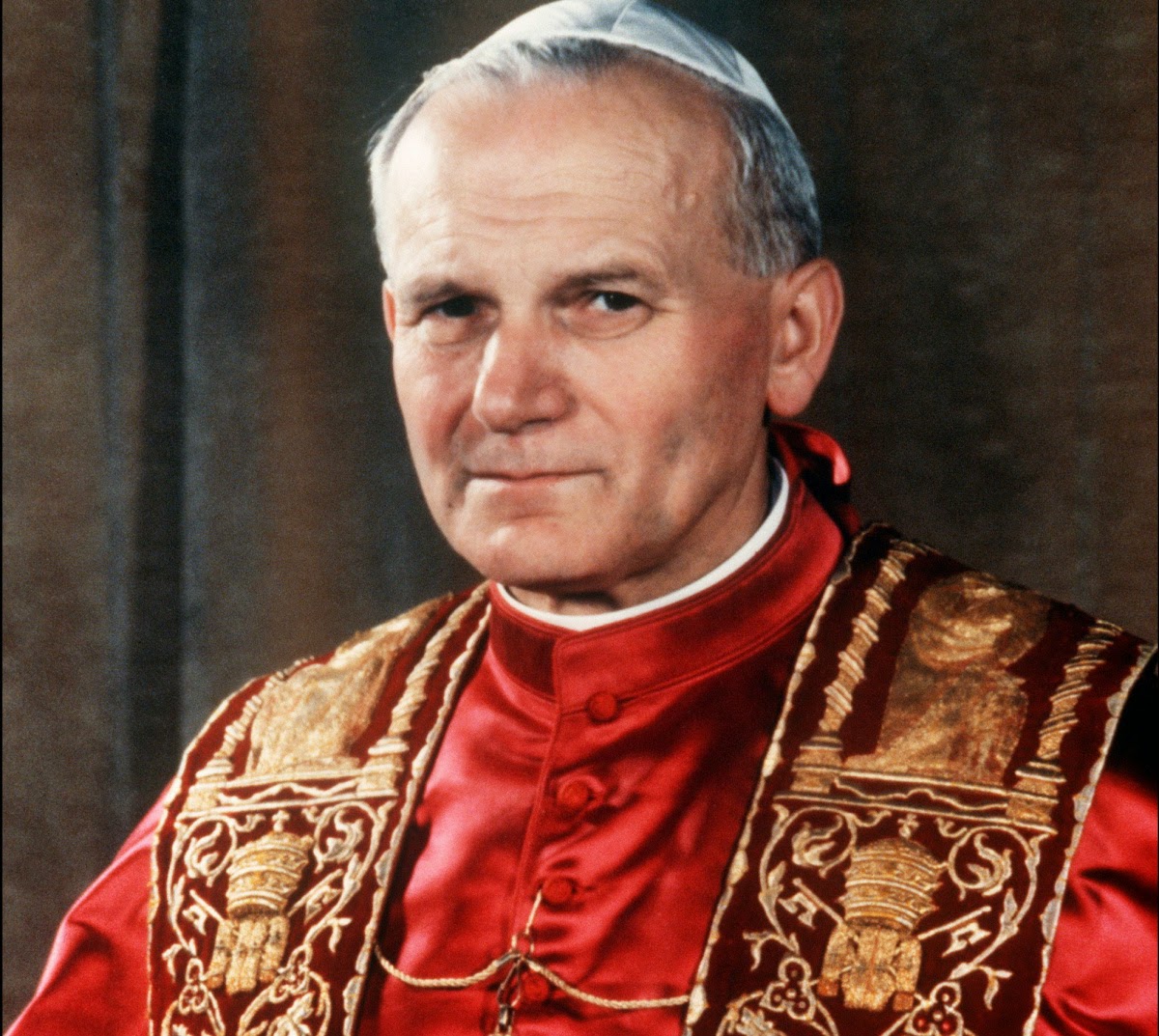
PRAYER TO ST. JOHN PAUL II


Oh , St. John Paul, from the window of heaven, grant us your blessing! Bless the church that you loved and served and guided, courageously leading it along the paths of the world in order to bring Jesus to everyone and everyone to Jesus. Bless the young, who were your great passion. Help them dream again, help them look up high again to find the light that illuminates the paths of life here on earth.

May you bless families, bless each family! You warned of Satan’s assault against this precious and indispensable divine spark that God lit on earth. St. John Paul, with your prayer, may you protect the family and every life that blossoms from the family.

Pray for the whole world, which is still marked by tensions, wars and injustice. You tackled war by invoking dialogue and planting the seeds of love: pray for us so that we may be tireless sowers of peace.

Oh St. John Paul, from heaven’s window, where we see you next to Mary, send God’s blessing down upon us all.


St. John Paul II, pray for us.


Friday, July 04, 2014

MEDITATIONS ON THE MYSTERIES OF THE ROSARY


“The Rosary is one of the traditional paths of Christian prayer directed to the contemplation of Christ’s face…

“After the announcement of the mystery and the proclamation of the word, it is fitting to pause and focus one’s attention for a suitable period of time on the mysteries concerned, before moving into vocal prayer. A discovery of the importance of silence is one of the secrets of practicing contemplation and meditation. One drawback of a society dominated by technology and the mass media is the fact that silence becomes increasingly difficult to achieve. Just as moments of silence are recommended in the Liturgy, so too in the recitation of the Rosary it is fitting to pause briefly after listening to the word of God, while the mind focuses on the content of a particular mystery (John Paul II, Apostolic Letter Rosarium Virginis Mariæ, October 16, 2002, nos. 18. 31).”

The meditations that follow are from Holy Rosary, written in 1931 by St. Josemaria Escriva. A meditation on the Luminous Mysteries did not appear in the Holy Rosary, but throughout his life St. Josemaria lovingly contemplated and preached on these scenes, just as he did with every chapter of the Gospels. Therefore, we have included here some excerpts from among his writings that make reference to the Luminous Mysteries to help readers meditate on the complete Rosary.

JOYFUL MYSTERIES

1. THE ANNOUNCIATION

Don’t forget, my friend, that we are children. The Lady of the sweet name, Mary, is absorbed in prayer.

You, in that house, can be whatever you wish: a friend, a servant, an onlooker, a neighbor…. For the moment I don’t dare to be anything. I hide behind you, and, full of awe, I watch what’s happening.

The Archangel delivers his message…. Quomodo fiet istud, quoniam virum non cognosco? “But how can this come about, since I am a virgin?” (Lk 1: 34). Our mother’s voice reminds me – by contrast – of all the impurities of men, … mine too.

The first decade is about to end…. I still have time to tell God, before anyone else does, “Jesus, I love you.”


2. THE VISITATION

By now, my little friend, you have no doubt learned to manage on your own. Joyfully keep Joseph and Mary company … and you will hear the traditions of the House of David. You will hear about Elizabeth and Zechariah, you will be moved by Joseph’s pure love, and your heart will pound whenever they mention the Child who will be born in Bethlehem.

We walk in haste towards the mountains to a town of the tribe of Judah (Lk 1: 39). We arrive. It is the house where John the Baptist is to be born. Elizabeth gratefully hails the mother of her Redeemer: “Blessed are you among women, and blessed is the fruit of your womb. Why should I be honored with a visit from the mother of my Lord?” (Lk 1: 42-43).

The unborn Baptist quivers… (Lk 1: 41), Mary’s humility pours forth in the Magnificat…. And you and I, who are proud – who were proud – promise to be humble.


3. THE NATIVITY

Caesar Augustus has issued a decree for a census to be taken of the whole world. For this purpose, everyone must go to the city of his ancestors. And, since Joseph belongs to the house and line of David, he goes with the Virgin Mary from Nazareth to the town of David, called Bethlehem, in Judea (Lk 2: 1-5).

And in Bethlehem is born our God: Jesus Christ! There is no room in the inn; he is born in a stable. And his mother wraps him in swaddling clothes and lays him in a manger (Lk 2: 7).

Cold. Poverty…. I am Joseph’s little servant. How good Joseph is! He treats me like a son. He even forgives me if I take the Child in my arms and spend hour saying sweet and loving things to him. And I kiss him – you kiss him, too! – and I rock him in my arms, and I sing to him and call him King. Love, my God, my Only-one, my All…. How beautiful is the Child… and how short the decade!


4. THE PRESENTATION

When the time has come for the mother’s purification, in accordance with the Law of Moses, the Child must be taken to Jerusalem to be presented to the Lord (Lk 2: 22).

And this time it will be you, my friend, who carries the cage with the doves (Lk 2: 24).

Just think: She – Mary Immaculate! – submits to the Law as if she were defiled. Through this example, foolish child, won’t you learn to fulfill the holy law of God regardless of any personal sacrifice?
Purification! You and I certainly do need purification.

Atonement and, more than atonement, love. Love as a searing iron to cauterize our soul’s uncleanness, and as a fire to kindle with divine flames the wretchedness of our hearts.

An upright and devout man has come to the Temple, led by the Holy Spirit (it has been revealed to him that he would not die until he had set eyes on the Christ). He takes the Messiah into his arms and says: “Now, my Lord, you can let your servant go from this world in peace, just as you promised, because my eyes have seen the Savior” (Lk 2: 25-30).


5. THE FINDING OF THE CHILD JESUS IN THE TEMPLE

Where is Jesus? The Child, my Lady! Where is he?

Mary is crying. In vain you and I have run from group to group, from caravan to caravan: no one has seen him. Joseph, after fruitless attempts to keep from crying, cries too…. And you…. And I.

Being a rough little fellow, I cry my eyes out and wail to heaven and earth,… to make up for the times when I lost him through my own fault and did not cry.

Jesus: may I never lose you again…. Then you and I are united in misfortune and grief, as we were united in sin. And, from the depths of our being come sighs of heartfelt sorrow and burning phrases, which the pen cannot and should not record.


And, as we are consoled by the joy of finding Jesus – three days he was gone! – debating with the teachers of Israel (Lk 2: 46), you and I will be left deeply impressed by the duty to leave our home and family to serve our heavenly Father.


LUMINOUS MYSTERY

1.BAPTISM OF OUR LORD

Then Jesus came from Galilee to the Jordan to John, to be baptized by him … and lo, a voice from heaven, saying, “This is my beloved Son, with whom I am well pleased” (Mt. 3: 13, 17).

In Baptism, our Father God has taken possession of our lives. He has made us sharers in Christ’s life and sent us the Holy Spirit.
The strength and the power of God light up the face of the earth.
We will set the world ablaze, with the flames of the fire that you came to enkindle on earth! And the light of your truth, our Jesus, will enlighten men’s minds in an endless day.

I can hear you crying out, my King, in your strong and ardent voice: ignem veni mittere in terram, et quid volo misi ut accendatur? I have come to bring fire to the earth, and would that it were already enkindled! And I answer, with my entire being, with all my senses and faculties: ecce ego: quia vocasti me! Here I am, because you have called me!

God has placed an indelible mark on your soul through Baptism: you are a child of God.

Child, are you not aflame with the desire to bring all men to love Him?


2. WEDDING FEAST AT CANA

Our Lady was a guest at one of those noisy country weddings attended by people from many different villages. Mary was the only one who noticed the wine was running out. Don’t these scenes from Christ’s life seem familiar to us? The greatness of God lives at the level of ordinary things. It is natural for a woman, a homemaker, to notice an oversight, to look after the little things that make life pleasant. And that is how Mary acted. Do whatever he tells you.

Implete hydrias (Jn 2: 7), fill the jars. And the miracle takes place. Everything is so simple and ordinary. The servants carry out their job. The water is easy to find. And this is the first manifestation of our Lord’s divinity. What is commonplace becomes something extraordinary, something supernatural, when we have the good will to heed what God is asking of us. Lord, I want to abandon all my concerns into your generous hands. Our Mother – your Mother – will have let you hear those words, now as in Cana: “They have no wine! …”

If our faith is weak, we should turn to Mary. Because of the miracle at the marriage feast at Cana, which Christ performed at his Mother’s request, his disciples learned to believe in him (Jn 2: 11) attend to our needs and show himself to us, so that we can cry out, “You are the Son of God.”

Grant me, dear Jesus, the faith I truly desire. My Mother, sweet Lady, Mary most holy, make me really believe.


3. PROCLAMATION OF THE KINGDOM OF GOD

The kingdom of God is at hand; repent, and believe in the gospel (Mk 1: 15).

And all the crowd gathered about him, and he taught them (Mk 2: 13).

Jesus sees the boats on the shore and gets into one of them. How naturally Jesus steps into the boat of each and everyone of us!
When you seek to draw close to our Lord, remember that he is always very close to you, that he is in you: regnum Dei intra vos est (Lk 17: 21). The kingdom of God is within you. You will find him in your heart.

Christ should reign first and foremost in our soul. But in order for Christ to reign in me, I need his abundant grace. Only in that way can my every heartbeat and breath, my least intense look, my most ordinary word, my most basic feeling be transformed into a hosanna to Christ my king.

Duc in altum. Put out into deep water! Throw aside the pessimism that makes a coward of you. Et laxate retia vestra in capturam. And pay out your nets for a catch!

We have to place our trust in our Lord’s words: get into the boat, take the oars, hoist the sails and lauch out into this sea of the world which Christ gives us as an inheritance.

Et regni ejus non erit finis. His kingdom will have no end.

Doesn’t it fill you with joy to work for such a kingdom?


4. TRANSFIGURATION OF OUR LORD

And he was transfigured before them, and his face shone like the sun, and his garments became white as light (Mt 17:2).

Jesus, we want to see you, to speak to you! We want to contemplate you, immersed in the immensity of your beauty, in a contemplation that will never cease! It must be wonderful to see you, Jesus! It must be wounded by your love!

And a voice from the cloud said, “This is my beloved Son, with whom I am well pleased; listen to him” (Mt 17:5).

Lord, we are ready to heed whatever you want to tell us. Speak to us: we are attentive to your voice. May your words enkindle our will so that we launch out fervently to obey you.

Vultum tuum, Domine, requiram (Ps 26:8). Lord, I long to see your face. I like to close my eyes and think that, when God wills, the moment will come when I will be able to see him, not as in a mirror dimly, but … face to face (1 Cor 13:12). Yes, my heart yearns for God, the living God. When shall I go and behold the face of God? (Ps 41: 3).


5. INSTITUTION OF THE EUCHARIST

Now before the feast of the Passover, when Jesus knew that his hour had come to depart out of this world to the Father, having loved his own who were in the world, he loved them to the end (Jn 13:1).

When our Lord instituted the Eucharist during the Last Supper, night had already fallen. The world had fallen into darkness, for the old rites, the old sign of God’s infinite mercy to mankind, were going to be brought to fulfillment. The way was opening to a new dawn – the new Passover. The Eucharist was instituted during that night, preparing in advance for the morning of the resurrection.
Jesus has remained in the Eucharist for love … for you.

He has remained, knowing how men would treat him … and how you would treat him.

He has remained so that you could eat him, and visit him and tell him your concerns; and so that, by your prayer beside the tabernacle and by receiving him sacramentally, you could fall more in love each day, and help other souls, many souls, to follow the same path.

Good child: see how lovers on earth kiss the flowers, the letters, the mementos of those they love…

Then you, how could you ever forget that you have him always at your side – yes, Him? How could you forget… that you can eat him?

Lord, may I never again flutter along close to the ground. Illuminated by the rays of the divine Sun – Christ – in the Eucharist, may my flight never be interrupted until I find repose in your Heart.


SORROWFUL MYSTERIES

1. THE AGONY IN THE GARDEN

“Pray that you may not enter into temptation.” And Peter fell asleep. And the other apostles. And you, little friend, fell asleep… and I too was another sleepy-headed Peter.

Jesus, alone and sad, suffers and soaks the earth with his blood.
Kneeling on the hard ground, he perseveres in prayer… He weeps for you… and for me. The weight of the sins of men overwhelms him. Pater, si vis, transfer calicem istum a me: “Father, if you are willing, remove this cup from me… Yet not my will, but yours be done” (Lk 22: 42).

An Angel from heaven comforts him. Jesus is in agony. He continues prolixius, praying more intensely… He comes over to us and finds us asleep: “Rise,” he says again, “and pray that you may not enter into temptation” (Lk 22:46).

Judas the traitor: a kiss. Peter’s sword gleams in the night. Jesus speaks: “Have you come out as against a robber, with swords and clubs to capture me?” (Mk 14: 48).

We are cowards: we follow him from afar – but awake and praying. Prayer… Prayer…


2. THE SCOURGING AT THE PILLAR

Pilate speaks: “It is your custom that I release one prisoner to you at the Passover. Whom shall I set free: Barabbas – a thief jailed with others for murder – or Jesus?” (Mt 27:17).

The crowd, spurred on by their rulers, cry: “Put this man to death and release Barabbas” (Lk 23: 18).

Pilate speaks again: “What shall I do, then, with Jesus who is called Christ?” (Mt 27:22). Crucifige eum: “Crucify him!” (Mk 15: 14).

Pilate, for the third time, says to them: “Why, what evil has he done? I have found in him no crime deserving death” (Lk 23:22).
The clamor of the mob grows louder: “Crucify him; Crucify him!” (Mk 15:14).

And Pilate, wanting to please the crowd, releases Barabbas to them and orders Jesus to be scourged.

Bound to the pillar. Covered with wounds.

The blows of the lash sound upon his torn flesh, upon his undefiled flesh, which suffers for your sinful flesh. More blows. More fury. Still more… It is a last extreme of human cruelty.

Finally, exhausted, they untie Jesus. And the body of Christ yields to pain and falls limp, broken and half-dead.

You and I cannot speak. Words are not needed. Look at him, look at him… slowly. After this… can you ever fear penance?


3. THE CROWNING WITH THORNS

Our king’s eagerness for suffering has been fully satisfied! They lead my Lord to the courtyard of the palace, and there call together the whole troop (Mk 15: 16). The brutal soldiers strip his most pure body. They drape a dirty purple rag about Jesus. They place a reed, as a scepter, in his right hand.

The crown of thorns, driven in by blows, makes him a mock king… Ave, Rex Iudæorum: “Hail, King of the Jews!” (Mk 15: 18). And with their blows they wound his head. And they strike him… and spit on him.

Crowned with thorns and clothed in rags of purple, Jesus is shown to the Jewish crowd. Ecce Homo: “Here is the man!” And again the chief priests and their attendants raise the cry, saying, “Crucify him! Crucify him!” (Jn 19: 5-6).

You and I… haven’t we crowned him anew with thorns and struck him and spat on him?

Never again, Jesus, never again… And a firm and practical resolution marks the end of these ten Hail Marys.


4. THE CARRYING OF THE CROSS

Carrying his cross, Jesus goes out of the city to the place of the skull – called Golgotha in Hebrew (Jn 19:17). And they lay hold of a certain Simon from Cyrene, who is coming in from the country; and they make him take the cross and carry it behind Jesus (Lk 23:26). The prophecy of Isaiah (53:12) is being fulfilled – cum sceleratis reputatus est (“he was counted among the wicked”) – for two others are being led out with him to be put to death (Lk 23:32).

If anyone would follow me… Little friend, we are sad, living the Passion of our Lord Jesus. See how lovingly he embraces the cross. Learn from him. Jesus carries the cross for you: You… carry it for Jesus.

But don’t drag the cross… Carry it squarely on your shoulder, because your cross, if you carry it so, will not be just any cross… It will be the holy cross. Don’t carry your cross with resignation: resignation is not a generous word. Love the cross. When you really love it, your cross will be… a Cross without a cross.
And, surely, you will find Mary on the way, just as Jesus did.


5. THE CRUCIFIXION AND DEATH OF OUR LORD

For Jesus of Nazareth, King of the Jews, the throne of triumph is ready. You and I do not see him writhe on being nailed. Suffering all that can be suffered, he spreads his arms in the gesture of an Eternal Priest… The soldiers take his holy garments and divide them into four parts. In order not to tear the tunic, they cast lots to decide whose it shall be. And so, once more, the words of Scripture are fulfilled: “They parted my garments among them, and for my clothes they cast lots” (Jn 19:23-24).

Now he is on high… And close to her Son, at the foot of the cross, stand Mary… and Mary, the wife of Cleophas, and Mary Magdalene. And John, the disciple Jesus loved. Ecce Mater tua: “Behold your mother”: he gives us his mother to be ours.

Earlier, they had offered him wine mixed with vinegar, and, when he had tasted it, he would not drink it (Mk 27:34).

Now, he thirsts… for love, for souls. Consummatum est: “It is accomplished” (Jn 19:30). Foolish child, look: All this… he has suffered it all for you… And for me. Can you keep from crying?


GLORIOUS MYSTERIES

1. THE RESURRECTION

When the Sabbath was over, Mary of Magdala and Mary, the mother of James, and Salome, bought spices with which to anoint the dead body of Jesus. It is very early on the following day; just as the sun is rising, they come to the tomb (Mk 16: 1-2). And upon entering it they are dismayed, for they cannot find the body of our Lord. A youth, clothed in white, says to them: “Do not be afraid. I know that you seek Jesus of Nazareth. Non est hic, surrexit enim sicut dixit: He is not here; for he has risen, as he said” (Mt 28:5). He has risen! Jesus has risen: he is not in the tomb. Life has overcome death.

He appears to his most holy mother. He appears to Mary Magdalene, who is carried away by love. And to Peter and the rest of the apostles. And to you and me, who are his disciples and more in love than Mary Magdalene. The things we say to him! May we never die through sin; may our spiritual resurrection be eternal. And, before the decade is over, you kiss the wounds in his feet,… and I, more daring – because I am more a child – place my lips upon his open side.

2. THE ASCENSION

Now the Master is teaching his disciples: he has opened their minds to understand the Scriptures, and he appoints them witnesses of his life and his miracles, of his passion and death, and of the glory of his resurrection (Lk 24:45, 48). Then he brings them out as far as the outskirts of Bethany and blesses them. And as he does so, he withdraws from them and is carried up to heaven (Lk 24:51) until a cloud takes him out of sight (Acts 1:9).

Jesus has gone to the Father. Two angels in white approach us and say, “Men of Galilee, why do you stand looking up to heaven?” (Acts 1:11). Peter and the others go back to Jerusalem cum gaudio magno: “with great joy” (Lk 24:52). It is fitting that the sacred humanity of Christ should receive the homage, praise, and adoration of all the hierarchies of the angels and of all the legions of the blessed in heaven. But you and I feel like orphans: we are sad, and we go to Mary for consolation.

3. THE DESCENT OF THE HOLY SPIRIT

Our Lord has said: “I shall ask the Father, and he will give you another Advocate, another Consoler, to be with you for ever” (Jn 14:16). The disciples are gathered together in one room, when suddenly they hear what sounds like a powerful wind from heaven, the noise of which fills the entire house where they are assembled. At the same time something appears that seems like tongues of fire; these separate and come to rest on the head of each of them (Acts 2:1-3).

The apostles are so filled with the Holy Spirit that they seem to be drunk (Acts 2:13).

Then Peter stands up with the Eleven and addresses the people in a loud voice. We, people from a hundred nations, hear him. Each of us hears him in his own language – you and I in ours. He speaks to us of Christ Jesus and of the Holy Spirit and of the Father.

Peter is neither stoned nor thrown into prison. Of those who have heard him, three thousand are converted and baptized.

You and I, after helping the apostles administer Baptism, bless God the Father for his Son Jesus, and we, too, feel drunk with the Holy Spirit.

4. THE ASSUMPTION

Assumpta est Maria in cælum: gaudent angeli. God has taken Mary, body and soul, to heaven; and the angels rejoice!

So sings the Church. And so, with that same cry of joy, we begin our contemplation in this decade of Holy Rosary.

The Mother of God has fallen asleep. Around her bed are the twelve apostles (Matthias in the place of Judas).

And we also, through a grace respected by all, are at her side.

But Jesus wants to have his mother, body and soul, in heaven. And the heavenly court, arrayed in all its splendor, greets our Lady. You and I – children, after all – take the train of Mary’s magnificent blue cloak, and thus we are able to watch the marvelous scene.

The most blessed Trinity receives and showers honors on the Daughter, Mother and Spouse of God…. And so great is the Lady’s majesty that the angels exclaim: Who is she?

5. THE CORONATION OF THE BLESSED VIRGIN

You are completely fair, and without blemish. You are a garden enclosed, my sister, my Bride, an enclosed garden, a sealed fountain. “Veni, coronaberis”: Come, you shall be crowned” (Sg 4: 7, 12, 8).

If you and I have been able, we too would have made her Queen and Lady of all creation.

“A great sign appeared in heaven: a woman with a crown of twelve stars upon her head, adorned with the sun and the moon at her feet” (Rev 12: 1). Mary, Virgin without stain, has made up for the fall of Eve; she has crushed the head of hell’s serpent with her immaculate heel. Daughter of God, Mother of God, Spouse of God.
The Father, the Son, and the Holy Spirit crown her as the rightful Empress of the Universe.

And the angels pay her homage as her subjects… and the patriarchs and prophets and apostles… and the martyrs and confessors and virgins and all the saints… and all sinners, including you and me.


Thursday, July 03, 2014

STATIONS OF THE CROSS


STATIONS OF THE CROSS[1]

The Christian loves to follow the Way of the Cross in the Savior’s footsteps. The Stations, from the Praetorium to Golgotha and the tomb, trace the Passion and Death of Christ, who by his Holy Cross has redeemed the world. To understand the mystery of Redemption and the salvific meaning of suffering, one ought to meditate upon the sin. God is always with those who suffer. His omnipotence is manifested precisely in the fact that he freely accepted suffering. He could have chosen not to do so. He could have chosen to demonstrate his omnipotence even at the moment of Crucifixion.[2]

In the name of the Father, and of the Son, and of the Holy Spirit. Amen.

My Lord and my God,
under the loving eyes of our Mother,
we are making ready to accompany You
along this path of sorrow,
which was the price paid for our redemption.
We wish to suffer all that You suffered,
to offer You our poor, contrite hearts,
because You are innocent, and yet
You are going to die for us,
who are the only really guilty ones.
My mother, Virgin of sorrows,
help us to relive those bitter hours,
which your Son wished to spend on earth,
so that we, who were made from a handful of clay,
may finally live
in libertatem gloriae filiorum Dei,
in the freedom and glory of the children of God.

FIRST STATION
JESUS IS CONDEMNED TO DEATH

V. We adore you, O Christ, and we bless you.
R. Because, by your holy cross, you have redeemed the world.

It is after ten in the morning. The trial is moving to its close. There has been no conclusive evidence. The judge knows that his enemies have handed Jesus over to him out of envy, and he tries an absurd move: a choice between Barabbas, a criminal accused of robbery nad murder, and Jesus, who says he is Christ. The people choose Barabbas, and Pilate exclaims: What I am to do, then, with Jesus? (Mt 27:22). They all reply: Crucify him! The Judge insists: Why, what evil has he done? Once again they respond, shouting: Crucify him! Crucify him! Pilate is frightened by the growing uproar. So he sends for water and washes his hands in the sight of the people, saying as he does so: I am innocent of the blood of this just man; it is your affair (Mt 27:24). And having had Jesus scourged, he hands him over to them to be crucified. Their frenzied and possessed throats fall silent, as if God had already been vanquished.

*Jesus is all alone. Far off now are the days when the words of the Man-God brought light and hope to men’s hearts, those long processions of sick people whom he healed, the triumphant acclaim of Jerusalem when the Lord arrived, riding on a gentle donkey. If only men had wanted to give a different outlet for God’s love! If only you and I had recognized the day of the Lord!

SECOND STATION
JESUS TAKES UP HIS CROSS

V. We adore you, O Christ, and we bless you.
R. Because, by your holy cross, you have redeemed the world.

Outside the city, to the northwest of Jerusalem, there is a little hill: Golgotha is its name in Aramaic; locus Calvariae, in Latin: the place of skulls, or Calvary.
Offering no resistance, Jesus gives himself up to the execution of the sentence. He is to be spared nothing, and upon his shoulders falls the weight of the ignominious cross. But, through love, the cross is to become the throne from which he reigns.
The people of Jerusalem and those from abroad who have come for the Passover push their way through the city streets, to catch a passing glimpse of Jesus of Nazareth, the King of the Jews. There is a tumult of voices, and, now and then, short silences–perhaps when Jesus fixes his eyes on someone:
If anyone wishes to come after me, let him take up his cross daily and follow me (Mt 16:24).
How lovingly Jesus embraces the wood which is to bring him to death!

*Is it not true that as soon as you cease to be afraid of the cross, of what people call the cross, when you set your will to accept the will of God, then you find happiness, and all your worries, all your sufferings, physical or moral, pass away?
Truly the cross of Jesus is gentle and lovable. There, sorrows cease to count; there is only the joy of knowing that we are co-redeemers with him.

THIRD STATION
JESUS FALLS THE FIRST TIME

V. We adore you, O Christ, and we bless you.
R. Because, by your holy cross, you have redeemed the world.

The heavy cross cuts and tears into our Lord’s shoulders.
The crowd has swollen into a multitude, and the legionaries can scarcely contain the angry, surging mob which, like a river that has burst its banks, flows through the streets and alleyways of Jerusalem. The worn-out body of Jesus staggers now beneath the huge cross. His most loving heart can barely summon up another breath of life for his poor wounded limbs.
To his right and left, our Lord sees the multitude moving around like sheep without a shepherd. He could call them one by one by their names – by our names. There they are, those who were fed at the multiplication of the loaves and fishes, those who were cured of their ailments, those he taught by the lakeside, on the mountain and in the porticoes of the Temple.
A sharp pain pierces the soul of Jesus; our Lord falls to the ground, exhausted.

*You and I can say nothing: now we know why the cross of Jesus weighs so much. We weep over our wretched failings and also for the terrible ingratitude of the human heart. From the depths of our soul there comes an act of real contrition, which lifts us up from the prostration of sin. Jesus has fallen that we might get up: once and for all.

FOURTH STATION
JESUS MEETS HIS BLESSED MOTHER

V. We adore you, O Christ, and we bless you.
R. Because, by your holy cross, you have redeemed the world.

No sooner has Jesus has risen from his first fall than he meets his Blessed Mother, standing by the wayside where he is passing.
With immense love Mary looks at Jesus, and Jesus at his mother. Their eyes meet, and each heart pours into the other its own deep sorrow. Mary’s soul is steeped in bitter grief, the grief of Jesus Christ.
O all you that pass by the way, look and see, was there ever a sorrow to compare with my sorrow! (Lam 1:12)
But no one notice, no one pays attention; only Jesus.
Simeon’s prophecy has been fulfilled: Thine own soul a sword shall pierce (Lk 2:35).
In the dark loneliness of the Passion, our Lady offers her son a comforting balm of tenderness, of union, of faithfulness; a “yes” to the divine will.

*Hand in hand with Mary, you and I also want to console Jesus, by accepting always and in everything the will of his Father, of our Father.
Only thus will we taste the sweetness of Christ’s cross and come to embrace it with all the strength of Love, carrying it in triumph along the ways of the earth.

FIFTH STATION
SIMON OF CYRENE HELPS JESUS TO CARRY THE CROSS

V. We adore you, O Christ, and we bless you.
R. Because, by your holy cross, you have redeemed the world.

Jesus is exhausted. His footsteps become more and more unsteady, and the soldiers are in a hurry to be finished. So when they are going out of the city through the Judgment Gate, they take hold of a man who is coming in from a farm, a man called Simon of Cyrene, the father of Alexander and Rufus, and they force him to carry the cross of Jesus (cf. Mk 15:21).
In the whole context of the passion, this help does not add up to very much. But, for Jesus, a smile, a word, a gesture or a little bit of love is enough for him to pour out his grace bountifully on the soul of his friend. Years later, Simon’s sons, Christians by then, will be known and held in high esteem among their brothers in the faith. And it all started with this unexpected meeting with the cross.
I went to those who were not looking for me; I was found by those that sought me not (Is 65:1).

*At times the cross appears without our looking for it. It is Christ who is seeking us not. And if by chance, before this unexpected cross which, perhaps, is therefore more difficult to understand, your heart were to show repugnance… don’t give it consolations. And, filled with a noble compassion, when it asks for them, say to it slowly, as one speaking in confidence: “Heart: heart on the cross! Heart on the cross!”

SIXTH STATION
VERONICA WIPES THE FACE OF JESUS

V. We adore you, O Christ, and we bless you.
R. Because, by your holy cross, you have redeemed the world.

There is no beauty in him, nor comeliness: and we have seen him and there was no sightlines, that we should be attracted to him. Despised and the most abject of men, a man of sorrows and acquainted with infirmity; and his look was, as it were, hidden and despised. Whereupon we esteemed him not (Is 53:2-3).
It is the Son of God who is passing by, a madman… madly in love! A woman, Veronica by name, makes her way through the crowd, with a white linen cloth folded in her hands, and with this she reverently wipes the face of Jesus. Our Lord leaves the impression of his holy Face on the three parts of the veil.
The beloved face of Jesus, which had smiled upon children and was transfigured with glory on Mount Tabor, is now, as it were, concealed by suffering. But this suffering is our purification; the sweat and the blood which disfigure and tarnish his features, serve to cleanse us.

*Lord, help me to decide to tear off, through penance, this pitiful mask that I have fashioned with my wretched doings… Then, and only then, by following the path of contemplation and atonement, will my life begin to copy faithfully the features of your life. I will find myself becoming more and more like you.
We will be other Christs, Christ himself, ipse Christus.

SEVENTH STATION
JESUS FALLS A SECOND TIME

V. We adore you, O Christ, and we bless you.
R. Because, by your holy cross, you have redeemed the world.

Outside the walls of the city, the body of Jesus again gives away through weakness, and he falls a second time, amid the shouts of the crowd and the rough handling of the soldiers.
Infirmity of body and bitterness of soul have caused Jesus to fall again. All the sins of men – mine too – weigh down on his Sacred Humanity.
He has borne our infirmities and carried our sorrows, and we have taken him for a leper, and as one struck by God and afflicted. But he was wounded for our iniquities and bruised for our sins. On him fell the punishment that brought us salvation, and by his wounds we have been healed (Is 53:4-5).
Jesus stumbles, but his fall lifts us up; his death brings us back to life. To our falling again and again into evil, Jesus responds with his determination to redeem us, with an abundance of forgiveness. And, so that no one may despair, again he wearily raised himself, embracing the cross.

*May our stumbles and defeats separate us from him no more. Just as a feeble child throws himself contritely into the strong arms of his father, you and I will hold tightly to the yoke of Jesus. Only a contrition and humility like this can transform our human weakness into the fortitude of God.

EIGHT STATION
JESUS CONSOLES THE WOMEN OF JERUSALEM

V. We adore you, O Christ, and we bless you.
R. Because, by your holy cross, you have redeemed the world.

Among the people watching our Lord as he passes by are a number of women who, unable to restrain their compassion, break into tears, perhaps recalling those glorious days spent with Jesus, when everyone exclaimed in amazement: Bene omnia fecit (Mk 7: 37). He has done all things well.
But our Lord wishes to channel their weeping towards a more supernatural motive. He invites them to weep for sins, which are the cause of the Passion and which will draw down the rigor of divine justice:
Daughters of Jerusalem, weep not for me, but for yourselves and for your children…. For if they do these things to the green wood, what shall be done to the dry? (Lk 23: 38, 31).

*Your sins, my sins, the sins of all men, rise up. All the evil we have done and the good that we have neglected to do. The desolate panorama of the countless crimes and iniquities which we would have commited, if he, Jesus, had not strengthened us with the light of his most loving glance.
How little a life is for making atonement!

NINTH STATION
JESUS FALLS THE THIRD TIME

V. We adore you, O Christ, and we bless you.
R. Because, by your holy cross, you have redeemed the world.

Our Lord falls for the third time, on the slope leading up to Calvary, with only forty or fifty paces between him and the summit. Jesus can no longer stay on his feet: his strength has failed him, and he lies on the ground in utter exhaustion.
He offered himself up because it was his will; abused and ill-treated, he opened not his mouth, as a sheep led to the slaughter, dumb as a lamb before its shearers (Is 53: 7).
Everyone against him… the people of the city and those from abroad, and the Pharisees and the soldiers and the chief priests.… All of them executioners. His mother – my mother – weeps.
Jesus fulfills the will of his Father! Poor; naked. Generous: what is there left for him to surrender? Dilexit me, et tradidit semetipsum pro me (Gal 2: 20), he loved me and delivered himself up unto death for me.
* My God! May I hate sin and unite myself to you, taking the holy cross into my arms, so that I, in my turn, may fulfill your most lovable will … stripped of every earthly attachment, with no other goal but your glory … generously, not keeping anything back, offering myself with you in a perfect holocaust.

TENTH STATION
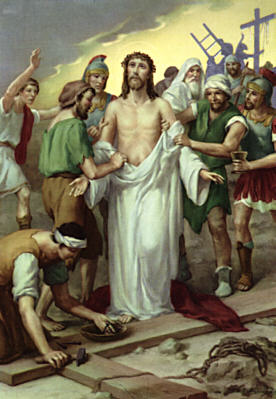
JESUS IS STRIPPED OF HIS GARMENTS

V. We adore you, O Christ, and we bless you.
R. Because, by your holy cross, you have redeemed the world.

When our Lord arrives at Calvary, he is given some wine to drink mixed with gall, as a narcotic to lessen in some way the pain of the crucifixion. But Jesus, after tasting it to show his gratitude for that kind service, he has not wanted to drink (cf Mt 27: 34). He gives himself up to death with the full freedom of love.
Then the soldiers strip Christ of his garments.
From the soles of his feet to the top of his head, there is nothing healthy in him: wounds and bruises and swelling sores. They are not bound up, nor dressed, nor anointed with oil (Is 1: 6).
The executioners take his garments and divide them into four parts. But the cloak is without seam, so they say:
It would be better not to tear it, but let us cast lots for it to see whose it shall be (Jn 19:24).
Thus, Scripture is again fulfilled: They divided my garments among them, and upon my vestures they cast lots (Ps 21: 19).

*Despoiled, stripped, left in the most absolute poverty, our Lord is left with nothing, save the wood of the cross.
For us to reach God, Christ is the way; but Christ is on the cross, and to climb up to the cross we must have our heart free, not tied to earthly things.

ELEVENTH STATION
JESUS IS NAILED TO THE CROSS

V. We adore you, O Christ, and we bless you.
R. Because, by your holy cross, you have redeemed the world.

Now they are crucifying our Lord, and with him two thieves, one on his right and one on his left. Meanwhile, Jesus says:
Father, forgive them for they do not know what they are doing (Lk 23: 34).
It is Love that has brought Jesus to Calvary. And, on the cross, all his gestures, all his words are of love, a love both calm and strong.
With a gesture befitting an eternal priest without father or mother, without lineage (cf. Hb 7: 3), he opens his arms to the whole human race.
With the hammer blows with which Jesus is being nailed, there resound the prophetic words of Holy Scripture: They have pierced my hands and feet. I can count all my bones, they stare and gloat over me (Ps 21: 17-18).
My people, what I done to thee, or in what have I saddened thee? Answer me! (Mi 6: 3).

*And we, our souls rent with sorrow, say to Jesus in all sincerity: I am yours, and I give my whole self to you; gladly I accept being nailed myself to the cross, ready to be in the crossroads of this world a soul dedicated to you, to your glory, to the work of Redemption, the co-redemption of the whole human race.

TWELFTH STATION
JESUS DIES ON THE CROSS

V. We adore you, O Christ, and we bless you.
R. Because, by your holy cross, you have redeemed the world.

On the uppermost part of the cross, the reason for the sentence is written: Jesus of Nazareth, King of the Jews (Jn 19:19). And all who pass by insult him and jeer at him. If he is the king of Israel, let him come down here and now from the cross (Mt 27: 42).
One of the thieves comes to his defense: This man has done no evil… (Lk 23: 41). Then, turn to Jesus, he makes a humble request, full of faith: Lord, remember me when thou comest into thy kingdom (Lk 23: 42). Truly, I say to thee: This day thou shalt be with me in Paradise (Lk 23: 43).
At the foot of the cross stands his mother, Mary, with other holy women. Jesus looks at her; then he looks at the disciple whom he loves, and he says to his mother: Woman, behold thy son. Then he says to the disciple: Behold thy mother (Jn 19: 26-27).
The sun’s light is extinguished, and the earth is left in darkness. It is close to three o’clock, when Jesus cries out. Eli, Eli, lamma sabacthani? That is:  My God, my God, why hast thou forsaken me? (Mt 27: 46).
Then, knowing that all things are about to be accomplished, that the scriptures may be fulfilled, he says: I am thirsty (Jn 19: 28).
The soldiers soak a sponge in vinegar and, placing it on a reed of hyssop, put it to his mouth. Jesus sips the vinegar, and exclaims: It is accomplished!
The veil of the temple is rent, and the earth trembles, when the Lord cries out in a loud voice: Father, into thy hands I commend my spirit. And he expires.

*Love sacrifice; it is a fountain of interior life. Love the cross, which is an altar of sacrifice. Love pain, until you drink, as Christ did, the very dregs of the chalice.

THIRTEENTH STATION
JESUS IS LAID IN THE ARMS OF HIS BLESSED MOTHER

V. We adore you, O Christ, and we bless you.
R. Because, by your holy cross, you have redeemed the world.

Mary stands by the cross, engulfed in grief. And John is beside her. But it is getting late, and the Jews press for our Lord to be removed from there.
Having obtained from Pilate the permission required by Roman law for the burial of condemned prisoners, there comes to Calvary a councilor named Joseph, a good and upright man, a native of Arimathea. He has not consented to their counsel and their doings, but is himself one of those waiting for the kingdom of God (Lk 23: 50-51). With him, too, comes Nicodemus, the same man who earlier visited Jesus by night; he brings with him a mizture of myrrh and aloes about a hundred pounds in weight (Jn 19: 39).
These men are not known publicly as disciple of the Master. They were not present at the great miracles, nor did they accompany him on his triumphal entry into Jerusalem. But now, when things have turned bad, when the others have fled, they are not afraid to stand up for the Lord.
Between the two of them they take down the body of Jesus and place it in the arms of his most holy mother. Mary’s grief is renewed.

*Where has thy Beloved gone, o fairest of women? Where has he whom thou lovest gone, and we will seek him with thee? (Cant 5: 17).
The Blessed Virgin is our mother, and we do not wish to – we cannot – leave her alone.

FOURTEENTH STATION
JESUS IS LAID IN THE TOMB

V. We adore you, O Christ, and we bless you.
R. Because, by your holy cross, you have redeemed the world.

Very near the Calvary, in an orchard, Joseph of Arimathea had had a new tomb made, cut out of the rock. Since it is the eve of the solemn Pasch of the Jews, Jesus is laid there. Then Joseph, rolling a great stone, close the grave door and goes away (Mt 27: 60).
Jesus came into the world with nothing. So, too, with nothing – not even the place where he rests – he has left us.
The mother of our Lord – my mother – and the women who have followed the Master from Galilee, after taking careful note of everything, also take their leave. Night falls.
Now it is all over. The work of our redemption has been accomplished. We are now children of God, because Jesus has died for us and his death has ransomed us. Empti enim esti pretio magno! (1 Col 6: 20). You and I have been bought at a great price.

*We must bring into our life, to make them our own, the life and death of Christ. We must die through mortification and penance, so that Christ may live in us through love. And then follow in the footsteps of Christ, with a zeal to co-redeem all mankind.
We must give our life for others. That is the only way to live the life of Jesus Christ and to become one and the same thing with him.



[1] St. Josemaria Escriva, The Way of the Cross, Princeton, N.J.: Scepter Publisher, 2976. Text reprinted here as “Stations of the Cross.”
[2] Cf. John Paul II, Apostolic Exhortation The Meaning of Suffering 14, Rome: Libreria Editrice Vaticana, 1984.